
.svg)

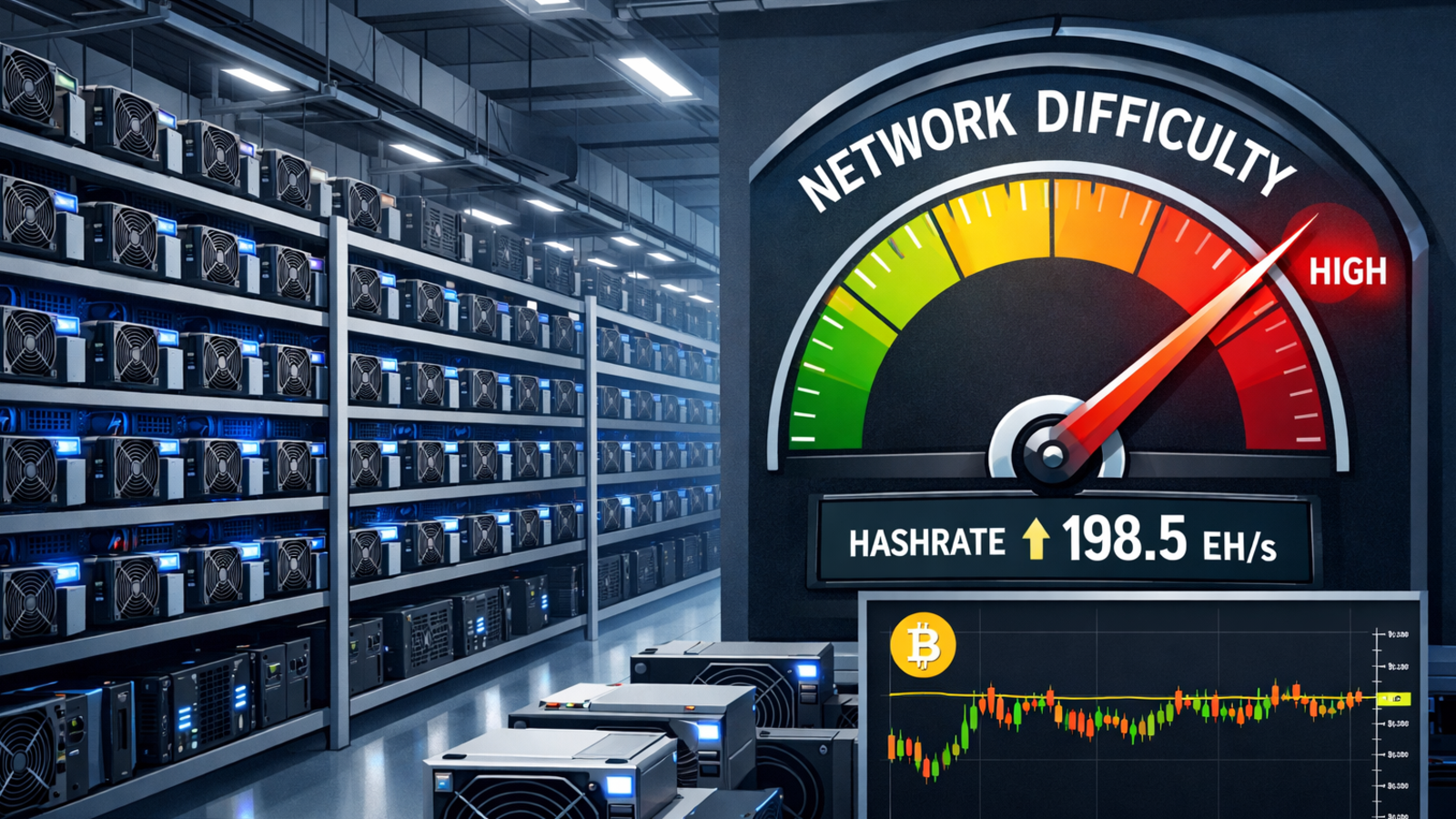
Bitcoin’s mining network just absorbed one of its sharpest resets in years. At the latest difficulty adjustment, the metric that governs how hard it is to mine a new block climbed to about 144.4 trillion, a 15 percent increase that ranks as the largest percentage rise since 2021, when the network was recovering from China’s mining crackdown. Difficulty is recalibrated every 2,016 blocks, roughly once every two weeks, to keep block production near ten minutes regardless of how much hashing power is online.
The latest move comes right after a pronounced setback in network capacity. In January and early February, severe winter weather in the United States disrupted power grids in major mining regions and pushed several large operators to throttle or temporarily halt activity. That contributed to a roughly 12 percent drop in difficulty and pulled hashrate down from a peak of about 1.1 zettahash per second to around 826 exahash per second, the steepest pullback in mining activity since late 2021. With power conditions improving and machines coming back online, hashrate has recovered to roughly 1 zettahash per second, which is what drove the 15 percent upward snap in difficulty.
All of this is happening against a softer price backdrop. When bitcoin set a record near 126,500 dollars in October, miners enjoyed both strong prices and record network throughput. By early February, spot prices had dropped toward 60,000 dollars before rebounding to around 67,000 dollars, even as the network’s security budget, as reflected by hashrate and difficulty, pushed back toward prior highs. That divergence means miners are now committing near peak computational power at a time when each unit of hash earns less in dollar terms than it did during the top.
The squeeze shows up clearly in hashprice, a metric that tracks estimated daily revenue per petahash of capacity. Current readings near 23.9 dollars per PH per day sit at multi year lows, which puts pressure on operators with older or less efficient fleets and on miners who pay higher energy costs. Yet large, well capitalized firms, especially those with access to cheap power, continue to run aggressively. Analysts note that some state backed and sovereign miners remain firmly profitable even at today’s hashprice levels, with operations in the United Arab Emirates, for example, sitting on hundreds of millions of dollars in unrealized gains. That combination of stressed margins for weaker players and sustained expansion by the strongest ones is helping keep hashrate elevated and is a key reason why difficulty could post such a large increase despite a market that is still well below its recent peak.





























































































.svg)
.svg)
.svg)
.svg)
.svg)
.svg)