
.svg)

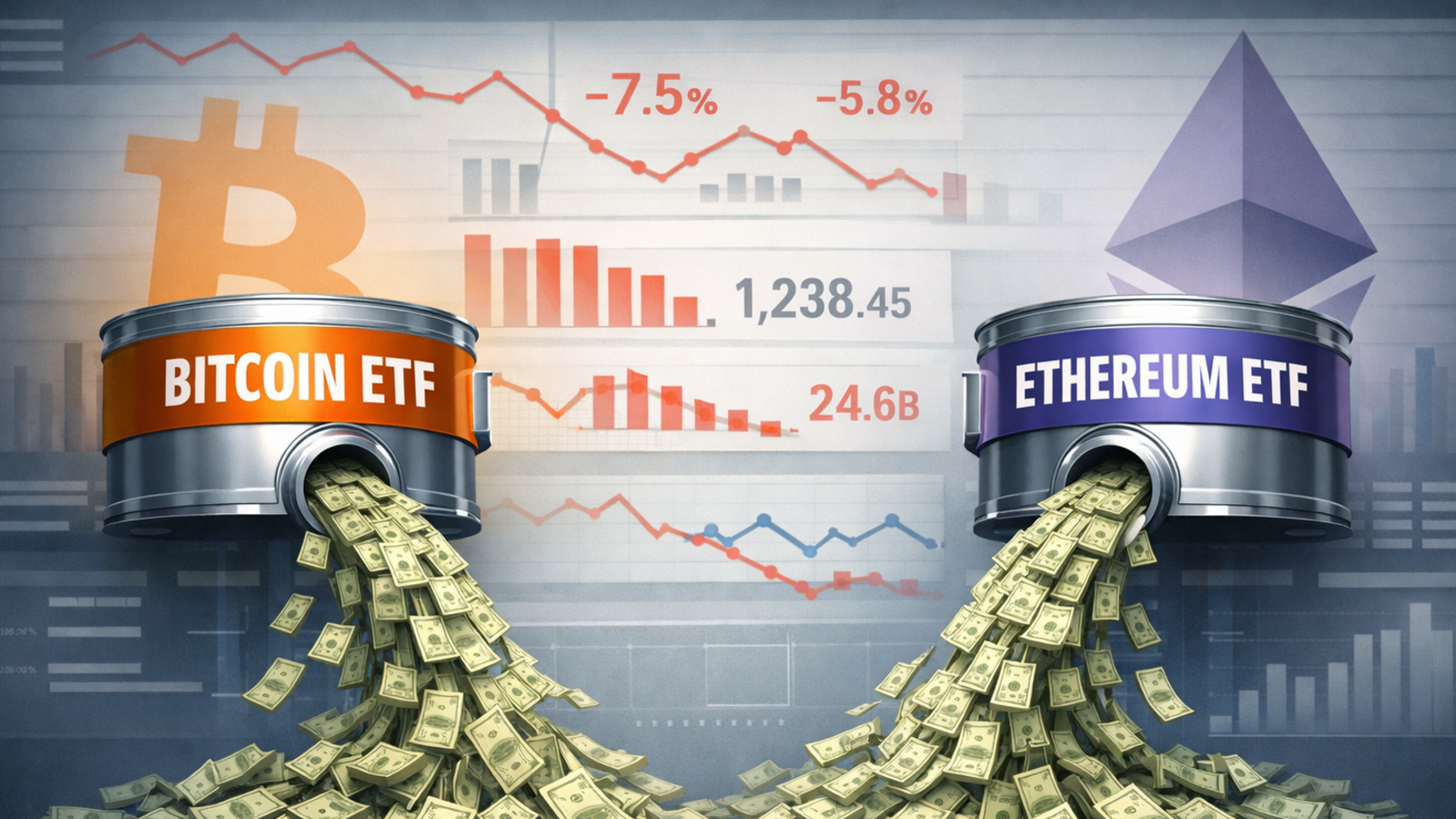
U.S.-listed spot bitcoin and ether ETFs have gone through their heaviest sustained withdrawal period since launch, with combined outflows topping $9 billion over the past four months. Bitcoin funds accounted for about $6.39 billion of that figure, while ether products lost roughly $2.76 billion, pointing to a broad pullback in institutional appetite rather than a one-off rotation between the two biggest assets.
The scale of those redemptions helps explain why both tokens have struggled so badly over the same stretch. Bitcoin, which traded above $126,000 in early October 2025, had fallen to around $67,000 by the time the outflow data was reported. Ether’s decline was even steeper, dropping more than 60% from highs above $4,950 reached in August 2025. In effect, the ETF market has become one of the clearest windows into how quickly institutional money has shifted from accumulation to defense.
What makes this episode stand out is not just the headline number, but the consistency of the selling. Bitcoin ETFs recorded four straight months of net redemptions, the longest monthly outflow streak since these products first began trading in early 2024. That kind of persistence suggests investors were not merely reacting to a single event. Instead, they appeared to be steadily reducing exposure as macro uncertainty, weaker momentum and falling crypto prices undermined confidence in the sector.
The message from the ETF tape is fairly direct. For much of the last cycle, spot funds were treated as proof that traditional finance was finally embracing crypto in size. This four-month reversal shows the relationship cuts both ways. When institutional sentiment cools, these same products can become a transmission channel for large-scale selling pressure. The result is a market where price weakness and ETF outflows start feeding each other, making it harder for bitcoin and ether to stabilize until buyers return in a meaningful way.


























































































.svg)
.svg)
.svg)
.svg)
.svg)
.svg)