
.svg)

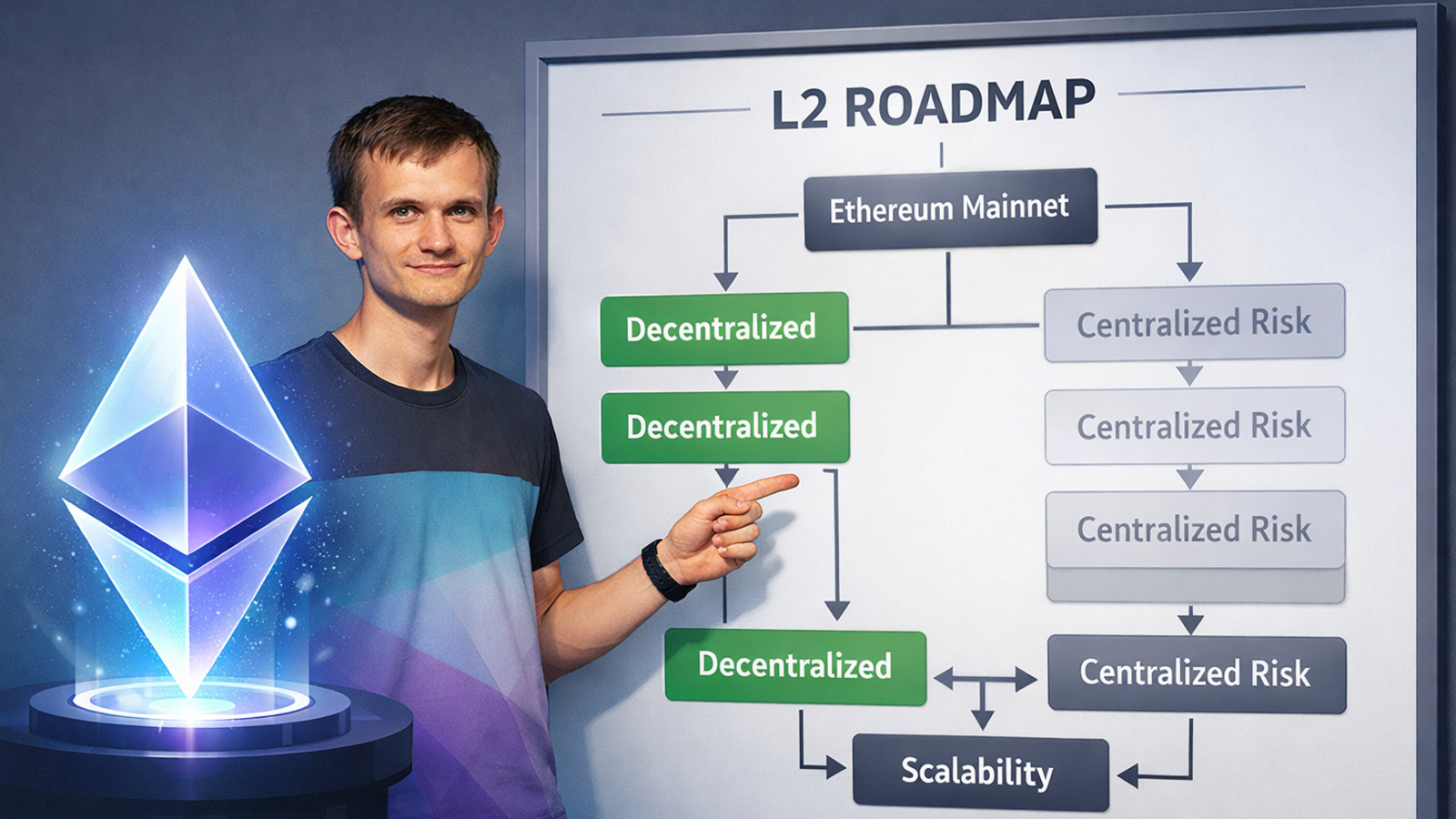
Ethereum co founder Vitalik Buterin has publicly said that the original “rollup centric” scaling roadmap no longer fits the reality of the network in 2026. In a detailed X thread he argued that the two core assumptions behind that plan have broken down. Ethereum’s base layer has become faster and cheaper than expected, while most layer 2 rollups have moved toward decentralization much more slowly than promised. What was once pitched as a future where almost all activity would live on L2s, with mainnet as a thin settlement layer, now looks to him like an outdated model.
Buterin points to two main shifts. First, upgrades like EIP 4844 and broader protocol improvements have pushed layer 1 capacity and fee reductions further than early forecasts, which means Ethereum is no longer as dependent on rollups to handle day to day usage. Second, many L2s still rely on centralized sequencers, multisig “security councils” and upgrade keys, rather than trustless fraud or validity proofs that run without human discretion. Only a small handful of networks such as Arbitrum, OP Mainnet and Base have reached what he calls Stage 1 decentralization, while most others remain at Stage 0 with high governance risk.
His warning elevates the “rollup stages” framework from a research tool into a legitimacy test. Under this scheme Stage 1 rollups must have live, permissionless fraud or validity proofs and strong limits on governance overrides, while Stage 2 aims for fully uncontestable proofs and code enforced governance. In Vitalik’s latest comments, Stage 1 is now the minimum standard for an L2 that wants to present itself as part of Ethereum’s core infrastructure. Networks that stay below that bar, even if they are technically called rollups, risk being viewed more like sidechains with extra trust assumptions than as true extensions of mainnet security.
The comments have triggered what some analysts describe as an identity crisis for the L2 ecosystem. Teams behind Arbitrum, Optimism, Base and Starknet have rushed to clarify their roadmaps and defend the role of rollups, arguing that high throughput and specialized execution environments still matter even as mainnet scales. Arbitrum co founder Steven Goldfeder warned that if Ethereum is seen as hostile to rollups, large institutions could respond by launching their own independent layer 1 chains instead of building on top of Ethereum. At the same time, outside commentators note that the pivot gives more weight to native ZK based scaling on layer 1 and makes the long term value of many generic L2 tokens less certain.
For builders and investors the message is blunt. Layer 2 networks are not “dead,” but they are now expected to prove real decentralization and clear reasons to exist beyond cheap blockspace. Vitalik’s shift suggests that future Ethereum growth will likely be shared between a more capable base layer, a smaller set of mature rollups that reach Stage 1 or Stage 2, and possibly new native rollup designs that live closer to the core protocol. Projects that cannot meet those expectations may still function, but they are unlikely to be treated as part of Ethereum’s trusted backbone in the years ahead.

































































































.svg)
.svg)
.svg)
.svg)
.svg)
.svg)