
.svg)

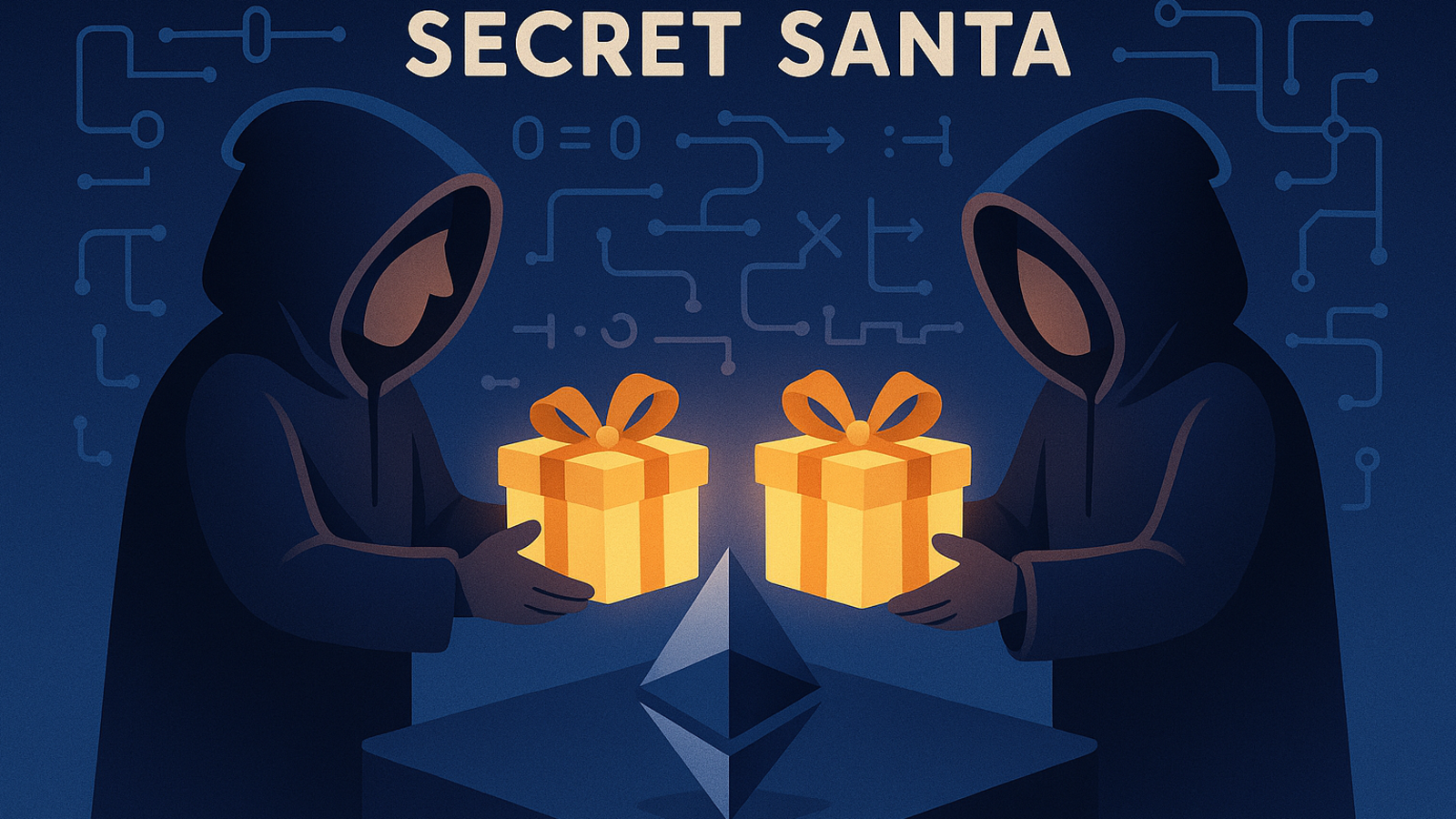
Ethereum developers are moving closer to deploying a new privacy protocol that borrows its structure from the classic Secret Santa gift exchange. The design, called Zero Knowledge Secret Santa or ZKSS, was first outlined by Solidity engineer Artem Chystiakov in a paper published on arXiv in January 2025 and has now resurfaced on the Ethereum community forum as researchers explore real deployment paths. The idea is to let a group of users swap gifts on chain while keeping the matchups hidden, using the exercise as a proving ground for stronger privacy tools on Ethereum.
Secret Santa is simple in the real world. Everyone draws a name and buys a present, but no one is supposed to know who picked whom. Doing that on Ethereum is much harder because every transaction is public, the base chain has no native randomness and there is always a risk that someone registers twice or assigns a gift to themselves. ZKSS tackles those constraints with zero knowledge proofs that verify the links between givers and receivers without revealing their identities, and with a matching algorithm that guarantees each participant appears exactly once as a sender and once as a recipient.
A key ingredient is the use of transaction relayers. Instead of sending transactions directly from their own wallets, participants hand their encrypted data to a relayer that broadcasts it on their behalf. That extra hop breaks the visible link between an Ethereum address and a particular action. At the same time, each user commits a random value and a signature to the smart contract, which helps generate a shared pool of randomness and blocks double entries. The protocol then builds a closed loop of assignments and allows each “Santa” to decrypt only the delivery details of their matched partner.
Developers and researchers see potential uses far beyond holiday games. The same primitives could support anonymous voting in DAOs, private token distributions, whistleblower channels or any setting where users need to prove that they are unique participants without exposing who they are interacting with. Work is now focused on hardening the code, cutting gas costs and preparing open source implementations that other projects can plug into. If the Secret Santa experiment succeeds, it would mark another step in Ethereum’s push to pair public verifiability with real privacy guarantees on a chain where everything is normally visible to everyone.
































































































.svg)
.svg)
.svg)
.svg)
.svg)
.svg)